In today's digital landscape, brands face an increasingly complex challenge when it comes to social media presence. The pressure to maintain an active, engaging presence across multiple platforms has never been higher, yet the resources to do so effectively remain scarce. Marketing teams find themselves caught in a cycle of reactive content creation, scrambling to respond to trends hours or even days after they emerge. Meanwhile, the need for platform-specific content means the same core message must be manually adapted multiple times, each version requiring careful attention to maintain brand consistency while respecting the unique culture and constraints of each platform. This problem becomes even more acute for smaller teams and individual creators who wear multiple hats. The hours spent crafting tweets, Reddit posts, and Mastodon updates are hours not spent on product development, customer engagement, or strategic planning. More critically, when different team members create content independently, subtle inconsistencies creep into the brand voice. What starts as a cohesive identity fragments across platforms, diluting the brand's impact and confusing its audience. The traditional solution of hiring dedicated social media managers or agencies comes with its own challenges. Beyond the obvious cost implications, there's an inherent risk in outsourcing your brand voice. External teams, no matter how skilled, rarely capture the authentic nuances that make a brand's communication truly distinctive. The result is often content that feels professional but generic, technically correct but lacking soul.
Building Paracket: From Concept to Reality
Paracket started as a project for my Branding and AI course at Northeastern University, born from an exploration of a fundamental question: could AI truly understand and replicate a brand's voice well enough to create authentic content? What began as an academic exercise quickly evolved into something much more. As I worked through the technical challenges and saw the system actually capture and reproduce authentic brand voices, I found myself genuinely passionate about the problem space. This is no longer just a course project, it's become a platform I'm committed to developing and refining long after the semester ends.
The answer to that initial question required more than just connecting APIs and prompting language models. It needed a systematic approach to capturing the essence of how a brand communicates across different contexts and platforms.
The n8n Foundation
The initial development happened in n8n, a powerful workflow automation platform that provided the perfect environment for rapid prototyping and iteration. The n8n canvas became a living laboratory where I could visually map out the entire content creation pipeline. Starting with data collection, I built workflows that systematically gathered content from Reddit, YouTube, and company blogs. Each source required its own careful handling, but the visual workflow approach made debugging and refinement intuitive. Reddit's API provided rich discussion data for understanding brand interactions. YouTube transcript extraction needed robust error handling for videos without captions. Blog scraping had to navigate the wild west of RSS feed formats and inconsistent HTML structures. By the end of the n8n development phase, all three data sources were working reliably.
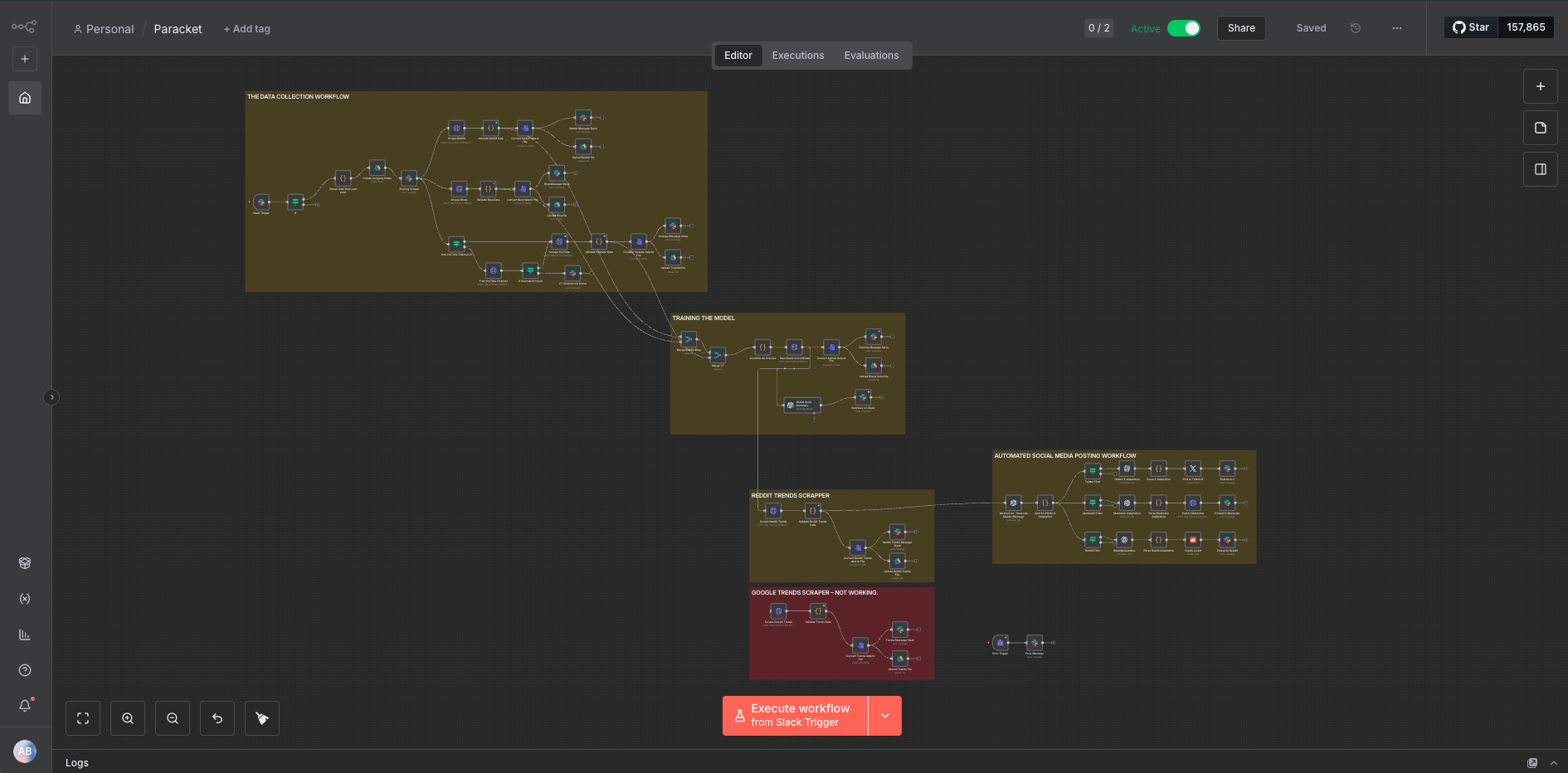
n8n workflow canvas showing the complete data collection and analysis pipeline
The breakthrough came with the brand voice analysis component. Rather than treating voice analysis as a simple sentiment classification task, I designed a multi-dimensional profiling system. Using GPT-4o, Paracket examines collected content samples to extract over ten distinct characteristics including tone, formality level, vocabulary patterns, sentence structure preferences, humor style, and topical focus. The prompt engineering for this analysis went through dozens of iterations, each refinement making the extracted profiles more nuanced and actionable. The goal was never to create a statistical model of word frequencies, but rather to capture the intangible qualities that make communication feel authentic.
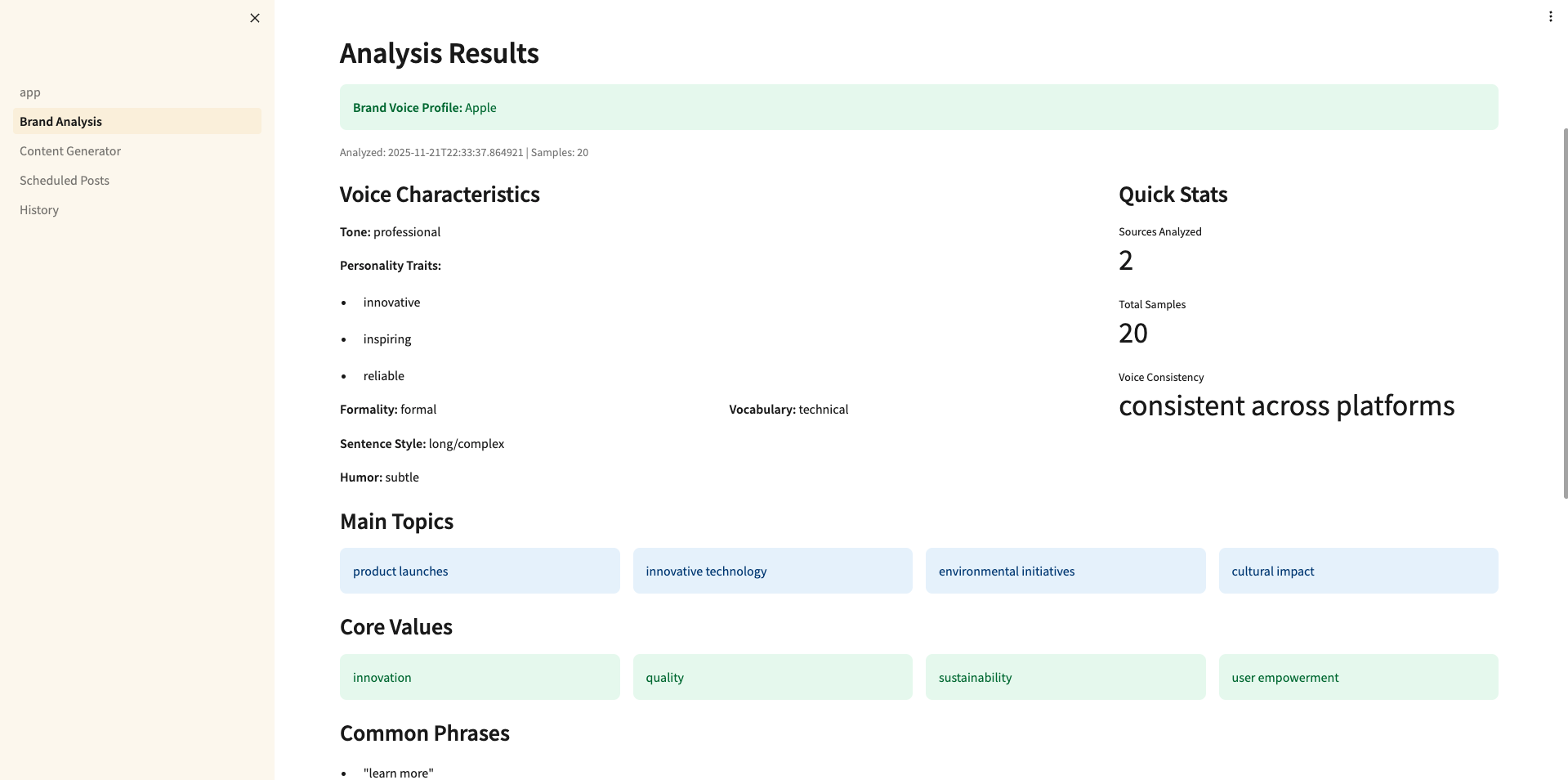
Sample brand voice analysis output showing the multi-dimensional profile
Content generation required an equally sophisticated approach. The n8n workflow integrated with Hacker News to identify trending topics relevant to each brand's domain. This wasn't just keyword matching, the system evaluates relevance, filters out controversial subjects, and prioritizes topics that align with the brand's established themes. The generation process creates a master message first, then adapts it for each platform while maintaining the core voice characteristics identified in the analysis phase.
As the system matured in n8n, a new challenge emerged: accessibility. The workflow automation platform was powerful but required technical knowledge to configure and operate. To make Paracket truly useful, it needed an interface that anyone could use without understanding the underlying complexity. This realization led to the development of the Streamlit application.
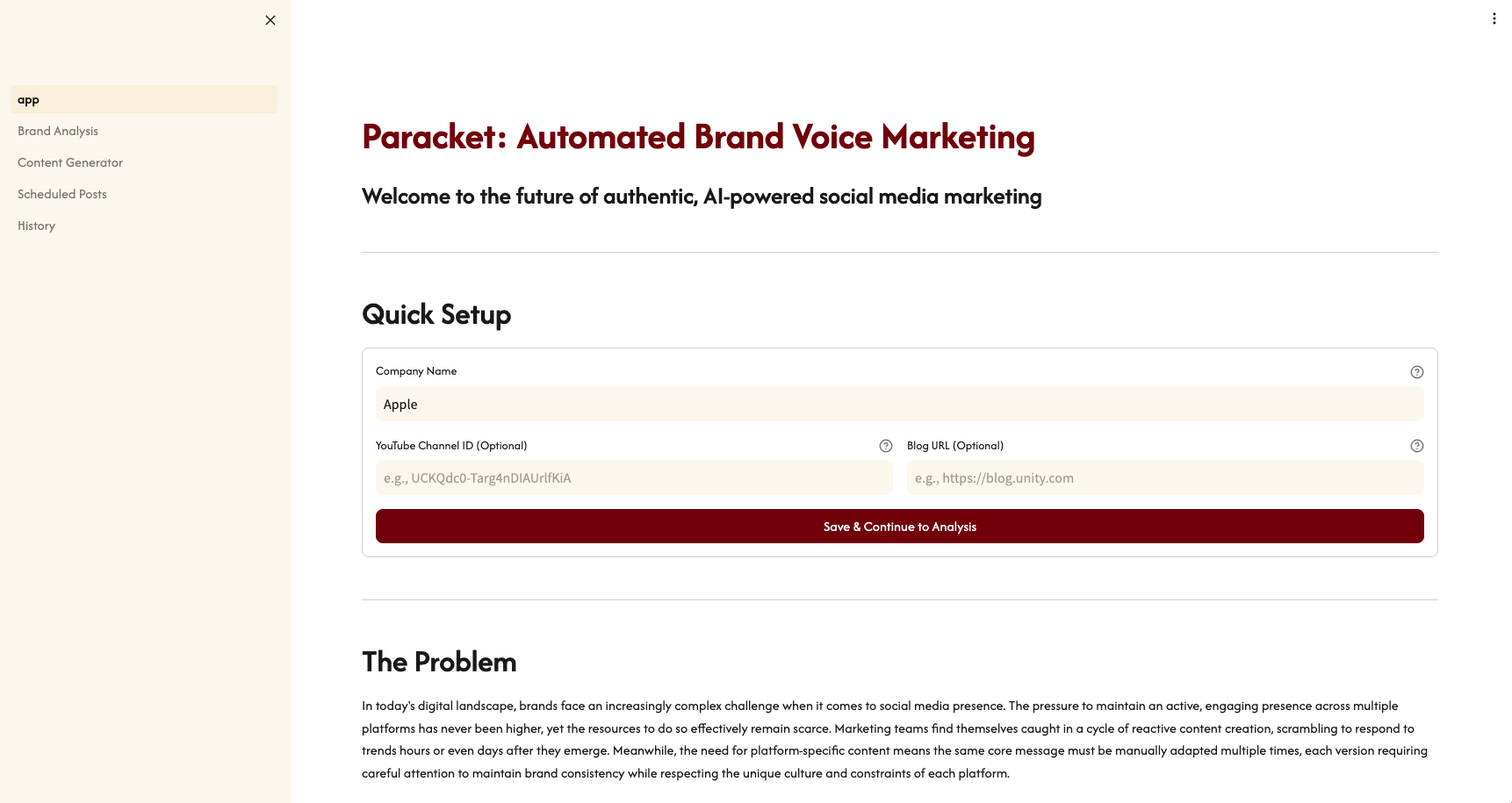
Streamlit home page showing the Quick Setup interface
The Streamlit interface prioritizes clarity and progressive disclosure. Users start with a simple form, company name, YouTube channel, and blog URL, but behind this simplicity lies the complex orchestration of API calls, data processing, and AI analysis. The Brand Analysis page guides users through data collection and voice profiling with real-time feedback, turning what could be an opaque process into a transparent, understandable journey.
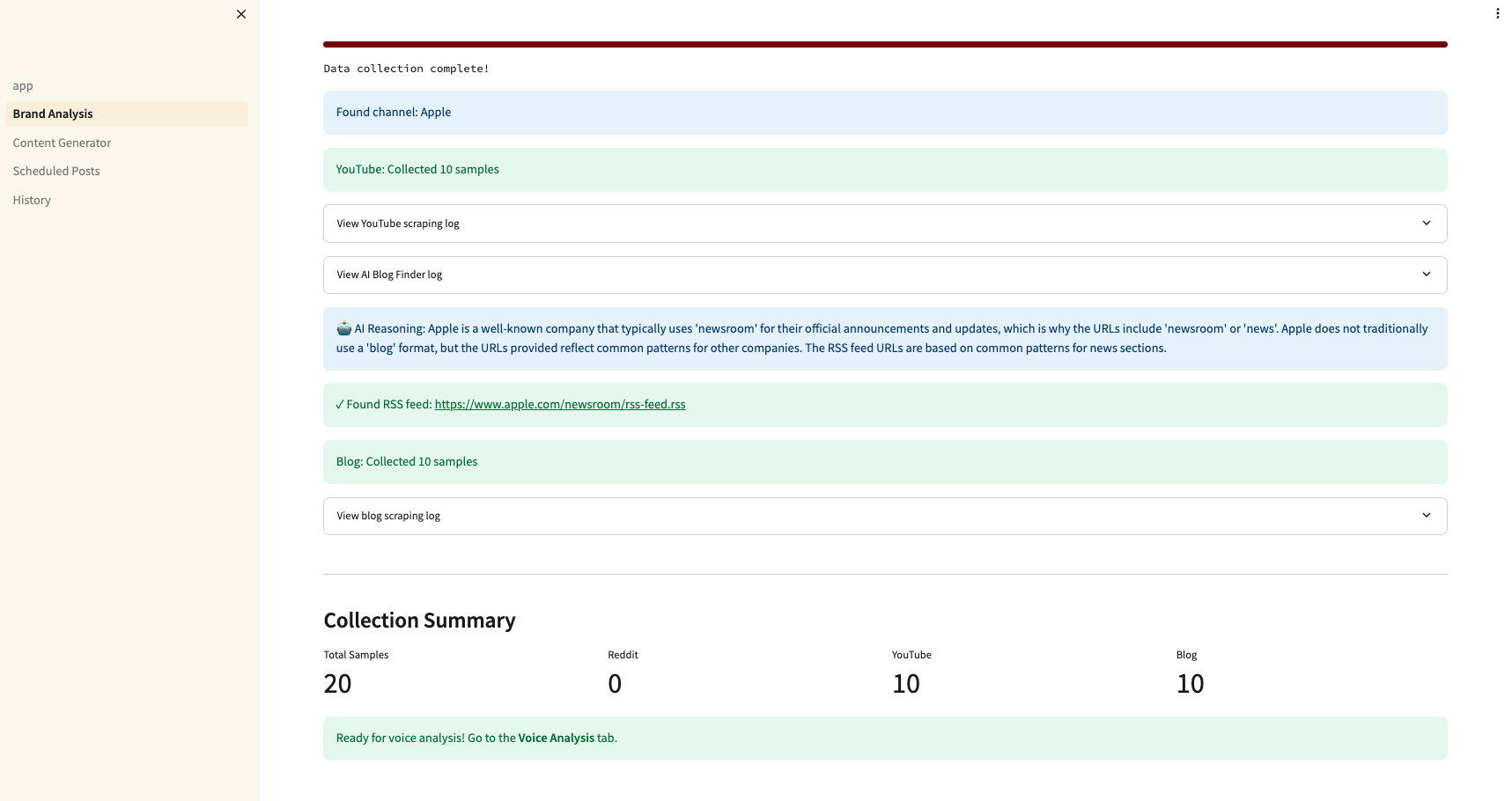
Brand Analysis page showing data collection in progress
The Content Generator then leverages this analysis to create platform-specific posts, presenting users with editable drafts rather than black-box outputs. This approach maintains user agency while providing AI-powered assistance.
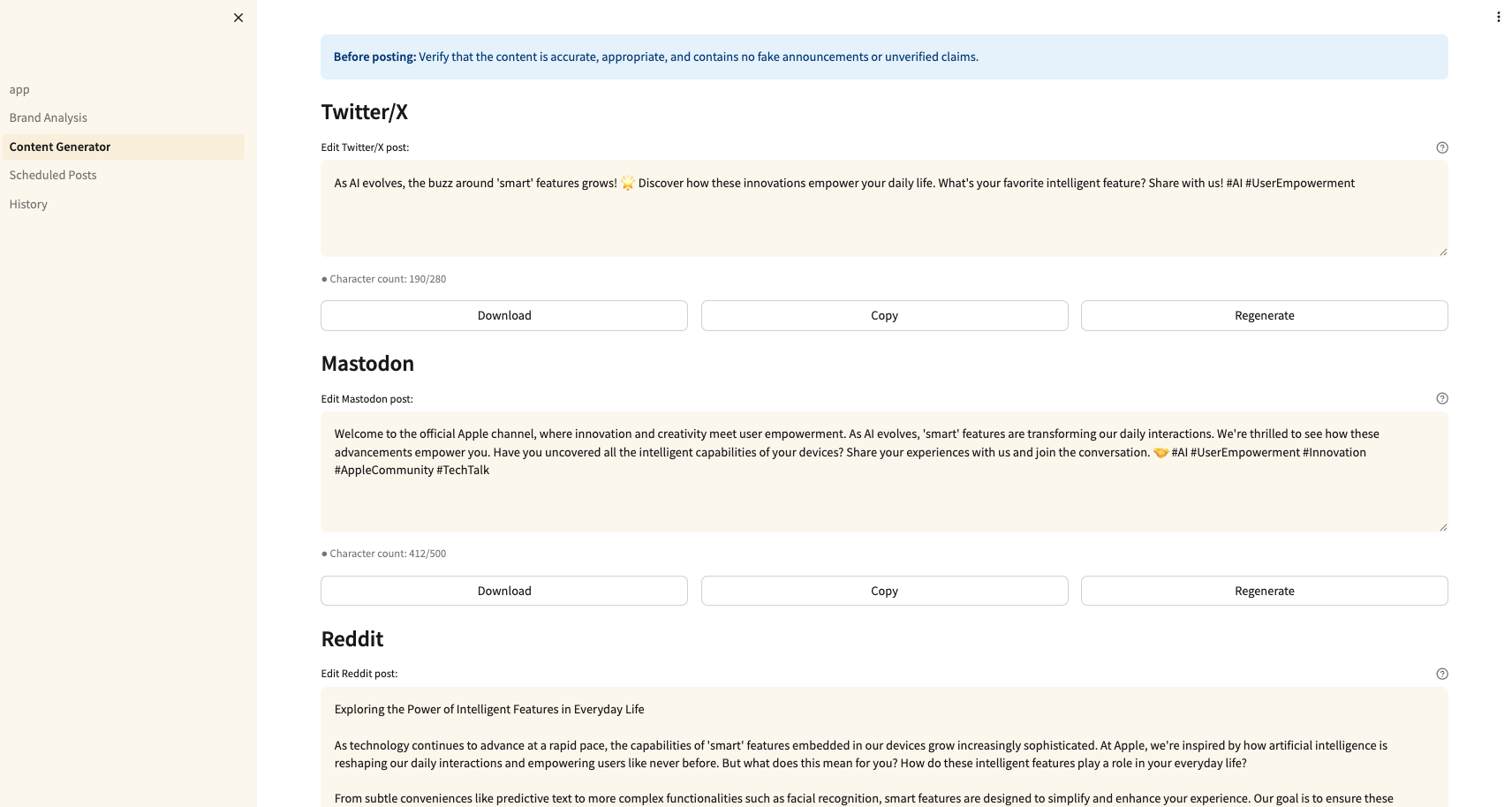
Content Generator showing platform-specific post adaptations
The scheduling system deserves special mention. While Streamlit excels at interactive applications, it lacks built-in support for background tasks and scheduled execution. The solution came through GitHub Actions, which runs the posting scheduler every five minutes in the cloud. This architecture elegantly separates concerns: Streamlit handles the user interface and content creation, while GitHub Actions manages the time-based automation. Posts created in the Streamlit UI are saved as JSON files, committed to the repository, and picked up by the scheduler at the appropriate time. After posting, status updates flow back through the same channel, creating a seamless experience despite the distributed architecture.
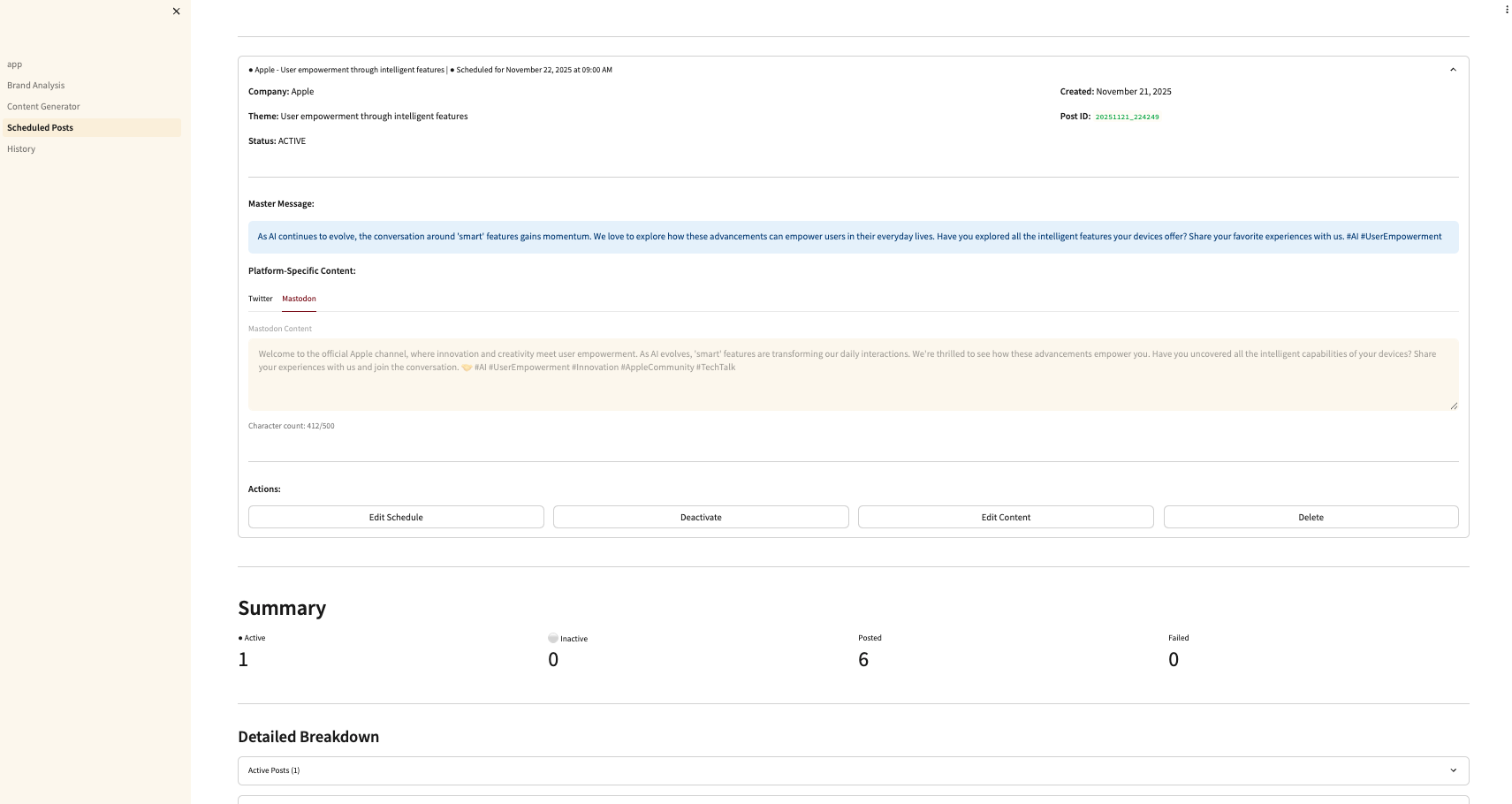
Scheduled Posts page showing post management interface
Challenges and Evolution
No development journey is without its obstacles, and Paracket encountered several significant challenges that shaped its current form. The most dramatic came unexpectedly during the final testing phase of the Streamlit UI. While the n8n workflow had been using Reddit successfully for weeks, something about the Streamlit implementation's request patterns triggered Reddit's automated fraud detection systems. My account was banned today, just as I was preparing to demonstrate the complete system. This was particularly frustrating because Reddit had been working perfectly, the ban came not from a flaw in the original design, but from the subtle differences in how the Streamlit UI made API calls compared to the n8n workflow.
The Reddit setback, while unexpected and poorly timed, forced a fundamental rethinking of the trend discovery mechanism. Rather than treating it as a catastrophic failure, I saw it as an opportunity to build something more resilient. The solution was to diversify beyond any single platform. I quickly implemented Hacker News as the primary trend source, leveraging its reliable API and tech-focused community. To this, I added Product Hunt for product launch trends and Dev.to for developer content. This rapid pivot not only replaced the lost Reddit functionality but actually improved the system's robustness. Now, if one source has limited data for a particular brand, others fill the gap. What started as an emergency fix became a genuine architectural improvement.
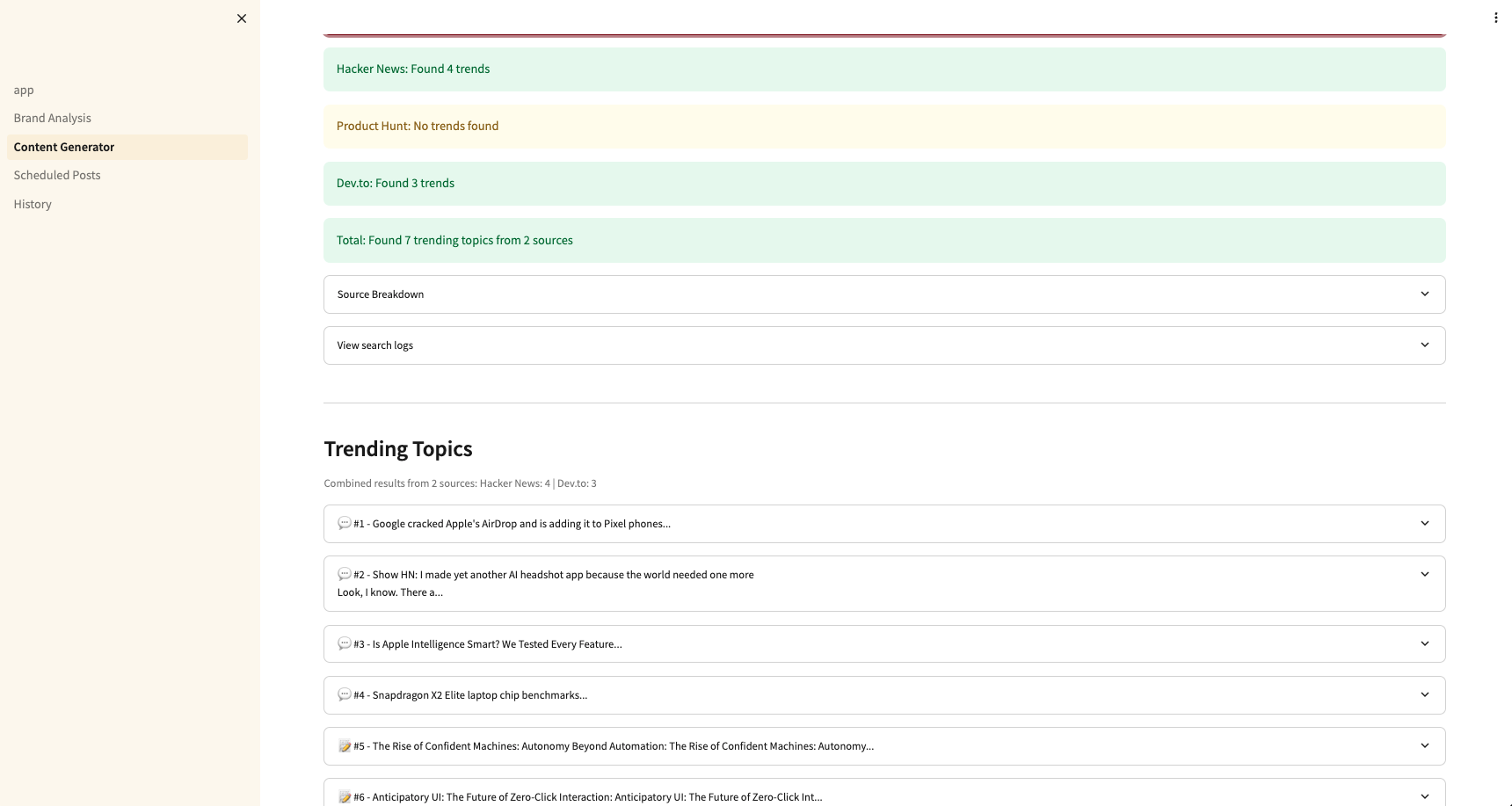
Trending Topics interface showing combined results from Hacker News, Product Hunt, and Dev.to
The blog discovery process presented another persistent challenge. Early versions relied on pattern matching and domain guessing to find company blogs and RSS feeds. This worked for companies with obvious naming conventions but failed frequently for brands with unconventional blog locations or non-standard feed formats. The breakthrough came from applying AI to the problem itself. Rather than hardcoding patterns, Paracket now uses GPT-4o to intelligently suggest likely blog URLs based on company names and common patterns. The AI considers variations in naming, common subdomain structures, and even leverages knowledge about well-known companies. This approach dramatically improved the success rate of blog discovery.
Technical challenges extended to the nuances of each platform's API. Twitter's character limits required sophisticated text condensation that maintained meaning while fitting constraints. Mastodon's decentralized nature meant handling instance-specific variations. YouTube's transcript extraction needed to gracefully handle videos without captions, multiple language options, and auto-generated versus human transcripts. Each of these edge cases required careful handling to prevent the entire pipeline from failing due to a single problematic data source.
Where Paracket Stands Today
The current implementation of Paracket represents a mature, functional system that successfully addresses the core challenge of authentic, automated content creation. Users can analyze any brand's voice using YouTube videos and blog posts as primary sources, with optional Reddit data for those with active accounts. The AI-powered blog finder successfully locates RSS feeds for most companies, dramatically reducing the manual configuration required.
The content generation pipeline now pulls trends from three sources simultaneously, Hacker News, Product Hunt, and Dev.to, ensuring sufficient relevant topics for any tech-focused brand. The multi-platform adaptation system creates content optimized for Twitter's brevity, Mastodon's community focus, and Reddit's conversational depth. Each piece maintains the brand voice characteristics identified during analysis while respecting platform-specific conventions.
The scheduling infrastructure, powered by GitHub Actions, provides reliable time-based posting without requiring dedicated servers or complex infrastructure. Posts created in the Streamlit interface flow seamlessly through the system, get posted at the scheduled time, and report back their status. The entire process remains transparent to users through the Scheduled Posts interface, where they can monitor, edit, or cancel upcoming posts.
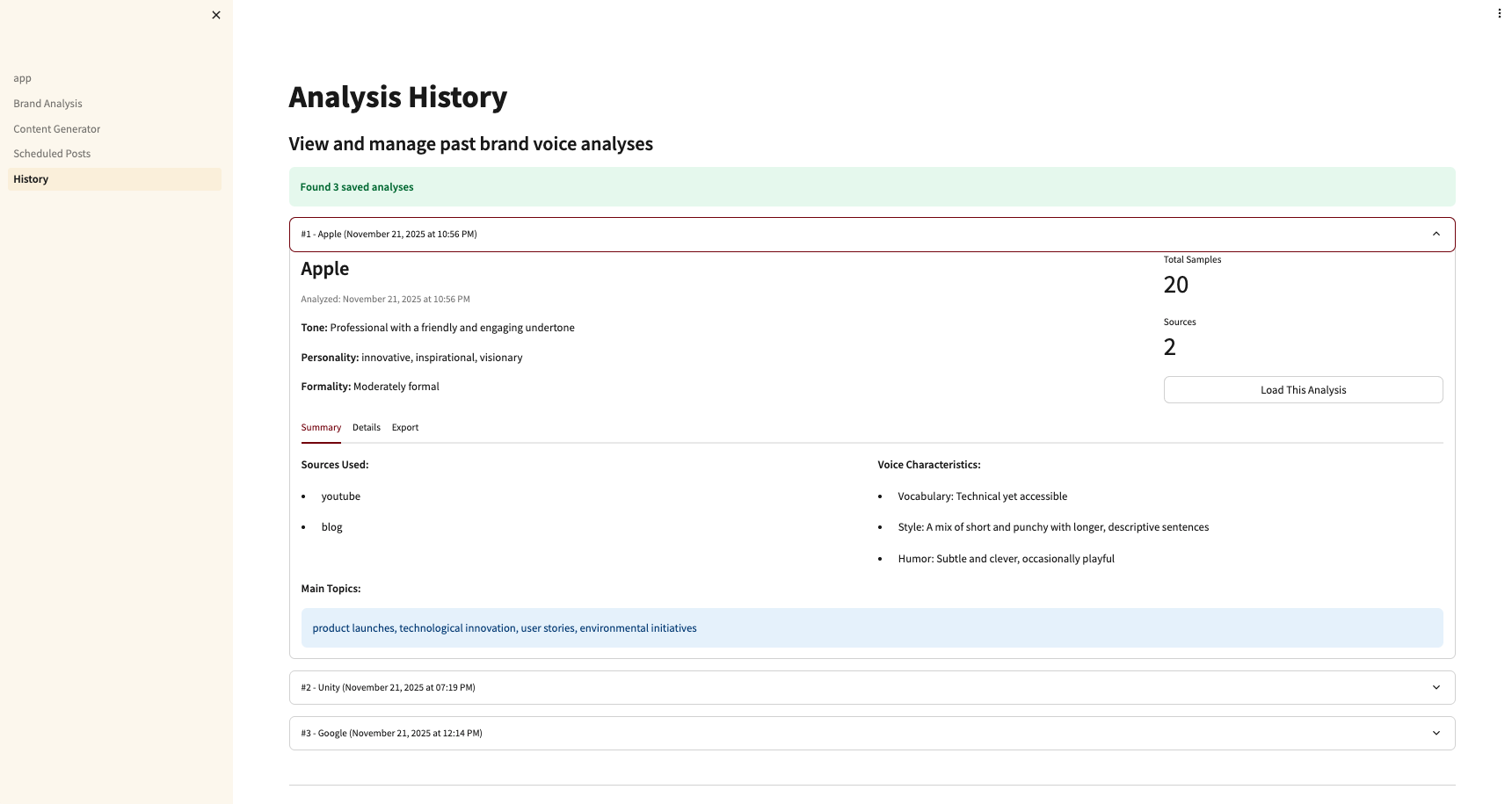
Post history showing successful multi-platform posts
Perhaps most importantly, the system maintains a balance between automation and control. Users review and approve all generated content before scheduling. They can edit any aspect of the posts, adjust timing, or regenerate content that doesn't quite hit the mark. Paracket acts as an intelligent assistant rather than a black box, amplifying human creativity rather than replacing it.
The Road Ahead
The next phase of Paracket's evolution focuses on two major enhancements that will transform it from a content creation tool into a comprehensive social media management platform with learning capabilities.
The first priority involves restoring Reddit integration once my account is unbanned. Since Reddit was working perfectly in the n8n workflow, I know the data collection approach is sound, the issue lies specifically in how the Streamlit UI makes requests. The fix will involve analyzing the differences between the n8n and Streamlit implementations to identify what triggered the ban, then implementing more sophisticated request patterns that better mimic human behavior. This will include adaptive rate limiting that responds to API feedback, randomized delays between requests, and more careful session management. The goal is to restore the Reddit functionality that was working before while ensuring it remains stable in the Streamlit environment.
The more ambitious enhancement involves adding a comprehensive analytics dashboard to the main page. This dashboard will integrate with each platform's API to track actual performance metrics for posts created by Paracket. Users will see impressions, engagement rates, click-throughs, and other key metrics directly within the application. But the dashboard serves a purpose beyond simple reporting, it becomes a feedback loop for the AI.
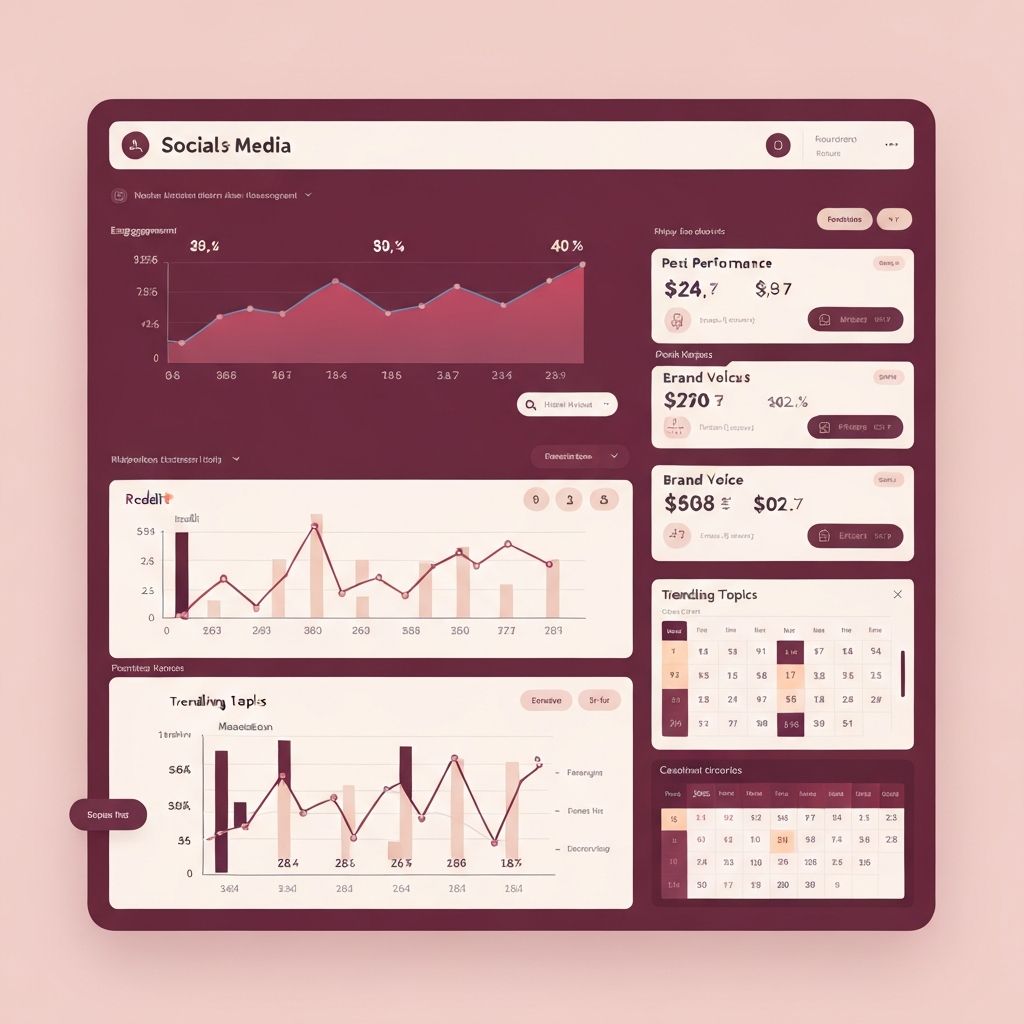
Mockup of future analytics dashboard
The vision is to create a self-improving system where Paracket learns from the performance of the content it generates. If certain voice characteristics or content structures consistently generate higher engagement, the system will weight those factors more heavily in future analysis and generation. If platform-specific adaptations perform differently across brands, the AI will adjust its approach accordingly. This transforms Paracket from a static content generator into an adaptive system that evolves with your brand and audience.
The machine learning component will analyze correlations between voice profile characteristics and engagement metrics. It will identify which topics resonate with which audiences, which posting times generate the most interaction, and which types of content adaptations work best for each platform. Over time, the brand voice profile becomes not just a snapshot of how you currently communicate, but a living model that incorporates what actually works.
This future vision maintains Paracket's core principle: augmenting human creativity rather than replacing it. The analytics and learning systems provide insights and suggestions, but users retain full control over their content and strategy. The goal is to make social media management not just easier, but genuinely more effective through intelligent automation that learns from real-world results.
Technical Architecture
Current Stack
Frontend & Interface:
- Streamlit for web application UI
- Custom CSS with Afacad and Homemade Apple fonts
- Session state management for user data persistence
Backend & Processing:
- Python 3.9+
- OpenAI GPT-4o for brand voice analysis and content generation
- Multiple API integrations (Twitter, Reddit, Mastodon, YouTube, Hacker News, Product Hunt, Dev.to)
Data Collection:
- PRAW for Reddit API
- Google YouTube Data API v3
- RSS feed parsing with feedparser
- Web scraping with BeautifulSoup4
- AI-powered blog URL discovery
Automation & Scheduling:
- GitHub Actions for time-based post scheduling
- JSON file-based post storage
- Git-based state synchronization
Deployment:
- Streamlit Cloud for web application hosting
- GitHub Actions for background scheduler
- GitHub repository for shared data storage
Key Design Decisions
Multi-Source Trend Discovery: Rather than relying on a single platform, Paracket aggregates trends from Hacker News, Product Hunt, and Dev.to. This provides redundancy and ensures sufficient relevant content regardless of which platforms are active for any given brand.
AI-Powered Discovery: Using GPT-4o to find blog URLs rather than hardcoded pattern matching significantly improved success rates and reduced manual configuration.
GitHub Actions Integration: Choosing GitHub Actions for scheduling elegantly solved the Streamlit Cloud limitation of no background tasks, while keeping infrastructure costs at zero.
User Agency: Maintaining human oversight and editability throughout the content creation pipeline ensures quality and authenticity while still providing significant automation benefits.
Lessons Learned
Resilience Through Diversity: The unexpected Reddit ban during UI testing taught me the importance of not depending on any single data source. Even when something is working perfectly in one environment, it can fail in another. Diversifying across multiple platforms created a more robust system that can withstand individual platform issues.
AI as a Tool, Not a Solution: The most successful components use AI to augment human capability (like blog discovery and voice analysis) rather than trying to fully automate complex decisions.
Progressive Disclosure: Complex systems need simple interfaces. Breaking the workflow into clear steps (Setup → Analysis → Generate → Schedule) makes the system approachable despite its technical sophistication.
Embrace Constraints: Streamlit Cloud's limitations forced creative solutions like GitHub Actions integration, which ultimately resulted in a better architecture than initially planned.
Impact and Future Vision
What started as a course project has become something I'm genuinely passionate about continuing to develop. The core problem, authentic, automated content creation, remains unsolved in the market. Most social media tools either provide scheduling without content generation, or generate content that feels artificial and disconnected from brand identity.
Paracket represents a different approach: using AI to understand and amplify authentic brand voices rather than replacing them. The upcoming analytics integration will close the feedback loop, creating a system that doesn't just automate content creation but actively learns what works for each specific brand and audience.
The vision extends beyond just posting to social media. Imagine a system that understands your brand so well it can suggest not just what to post, but when to post it, which topics to engage with, and how your communication strategy should evolve based on real audience feedback. That's where Paracket is headed.
Current Capabilities
Data Sources: YouTube transcripts and descriptions, company blogs (AI-powered discovery), and optional Reddit content provide comprehensive brand voice samples.
Trend Discovery: Hacker News, Product Hunt, and Dev.to are monitored simultaneously to ensure sufficient relevant topics regardless of brand focus.
AI Technology: GPT-4o powers brand voice analysis, blog URL discovery, and multi-platform content generation with platform-specific optimization.
Supported Platforms: Twitter/X, Reddit, and Mastodon with automated posting via GitHub Actions scheduler.
Deployment: Free tier friendly Streamlit Cloud for hosting, GitHub Actions for scheduling, no database costs.
Let's Connect
Contact Information
Email:buildwithari.dev@gmail.com
Location:Boston, MA